
What Is Traditional Medicare? Original Medicare Explained Simply
If you have been told to enroll in “traditional Medicare,” that usually means Original Medicare. Original Medicare is the federal Medicare program made up of Part A and Part B. It is not the same as a Medicare Advantage plan. With Original Medicare, there is generally no plan network like many employer plans or HMOs, as long as the doctor or provider accepts Medicare. Medicare itself uses the term “Original Medicare,” not “traditional Medicare.”
A reader recently asked:
Good morning, Toni,
I have been reading your Medicare column, and now I need your Medicare help. I am retiring when I turn 65 in April. I was hospitalized in November of 2025 with a triple bypass surgery. Last week I talked with the office manager at my cardiologist’s office about enrolling in Medicare and what I should do. She said for me to enroll in “Traditional” Medicare.
I have no idea what “Traditional” Medicare is? Could you please explain what this is and make it easy to understand? I do not want to enroll in the wrong Medicare plan and have any issues having my medical bills paid. Thank you, Toni.
– Sean from Chattanooga, Tenn
That is a smart question, especially when you are getting ready to retire and want to make sure your doctors and hospital bills are covered correctly.
Traditional Medicare vs. Original Medicare

Many doctors’ offices and insurance agents casually say traditional Medicare, but Medicare’s official name for it is Original Medicare. In fact, you will not find the phrase “traditional Medicare” anywhere on the Medicare.gov website or in the Medicare & You handbook. Original Medicare includes only:
-
Medicare Part A for hospital insurance
-
Medicare Part B for medical insurance
It does not include:
-
Part C, which is Medicare Advantage
-
Part D, which is prescription drug coverage
-
Medigap, which is supplemental coverage sold by private insurers
So when someone says “traditional Medicare,” they usually mean Original Medicare Parts A and B.
What does Original Medicare cover?
Medicare Part A
Part A helps cover:
-
inpatient hospital stays
-
skilled nursing facility care after a qualifying hospital stay
-
hospice care
-
some home health care
For 2026, the Part A inpatient hospital deductible is $1,736 per benefit period. For skilled nursing facility care, the daily coinsurance is $0 for days 1–20 and $217 per day for days 21–100.
Medicare Part B
Part B helps cover medically necessary outpatient and physician services, including:
-
doctor visits
-
outpatient surgery
-
lab work and diagnostic testing
-
durable medical equipment
-
outpatient hospital services
-
preventive services and other medical care
For 2026, the standard Part B premium is $202.90 per month for beneficiaries with income below the applicable IRMAA thresholds, and the Part B deductible is $283 for the year. Higher-income beneficiaries may pay more for Part B.
After you meet the Part B deductible, Medicare generally pays 80% of the Medicare-approved amount, and you pay 20%.
Does Original Medicare have a network?

One of the biggest differences between Original Medicare and many employer or private insurance plans is that Original Medicare does not work through a typical HMO or PPO network.
That is why many people find it confusing at first.
If a doctor, hospital, or provider accepts Medicare or accepts Medicare assignment, they can generally treat you under Original Medicare. That broad provider access is one reason some doctors’ offices prefer patients to stay with Original Medicare rather than join a Medicare Advantage plan.
Why might a doctor’s office recommend Original Medicare?

A provider’s office may suggest Original Medicare because:
-
it is widely accepted
-
it usually gives patients more provider flexibility
-
referrals are generally less restrictive than many HMO-style plans
-
billing can be more straightforward when the provider accepts Medicare
That does not mean Original Medicare is always the best fit for every person. It just means your provider may be more comfortable working with that coverage model.
How do you pay what Medicare does not cover?

This is where many people get caught off guard. Original Medicare does not cap all of your out-of-pocket costs on its own. You still may owe deductibles, copays, and coinsurance. That is why many people pair Original Medicare with:
Medigap
A Medicare Supplement insurance policy, also called Medigap, helps pay some of the out-of-pocket costs that Original Medicare leaves behind. Medigap works with Original Medicare, not with Medicare Advantage. CMS notes that Medigap plans are designed to help with costs like deductibles, copayments, and coinsurance.
Part D
If you choose Original Medicare, you may also want a stand-alone Part D prescription drug plan for medication coverage.
Is Traditional Medicare the same as Medicare Advantage?
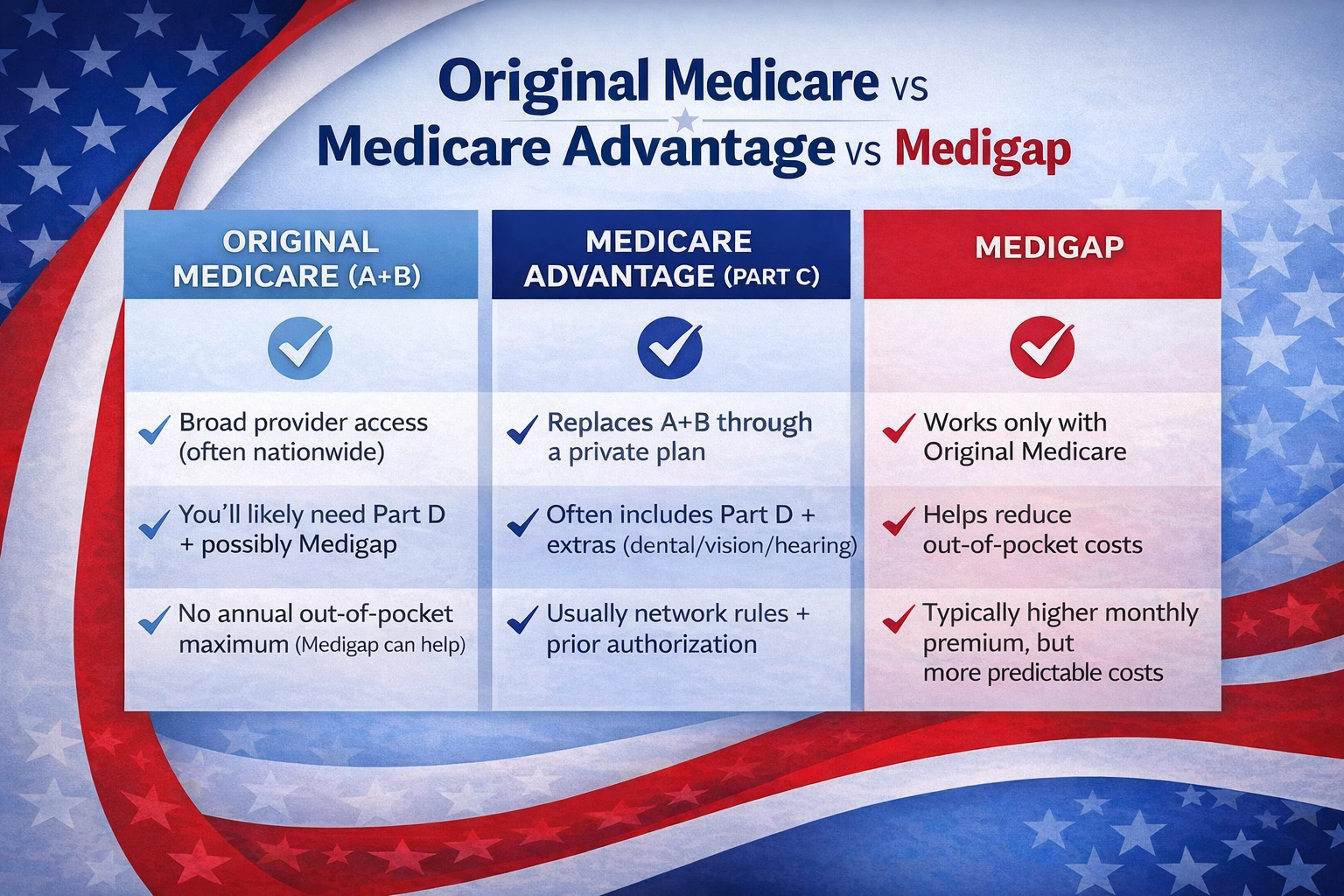
No. Traditional, or Original Medicare, is not the same as Medicare Advantage.
Original Medicare
-
run by the federal government
-
includes Part A and Part B
-
no typical HMO/PPO network structure
-
can be paired with Medigap
-
can be paired with a stand-alone Part D plan
Medicare Advantage
-
offered by private insurance companies approved by Medicare
-
often includes provider networks
-
may include drug coverage
-
cannot be paired with Medigap in the same way as Original Medicare
So if your doctor’s office told you to choose “traditional Medicare,” they were likely telling you to enroll in Original Medicare, not a Medicare Advantage plan.
Here’s my full answer to the reader question:
Hello Sean,
Don’t worry, Sean, I will make this easy for you. Let’s examine just what “Traditional” Medicare is.
Most health care professionals and office personnel call Medicare, “Traditional” Medicare, but Medicare refers to the federal health program as “Original” Medicare. You will not find “Traditional” Medicare anywhere in the Medicare.gov website or in the Medicare & You handbook.
Original or Traditional Medicare consists of only Medicare Parts A (Hospital Insurance) and B (Medicare) and not the rest of the alphabet soup such as Parts C or D. Original/Traditional Medicare is also known as your Medicare card.
There is not a network with “Original/Traditional” Medicare, and this is hard for those who have retired with employer group health insurance to understand, “NO Network”! If your hospital, doctor, or health care provider accepts “Original” Medicare or Medicare assignment, then they will accept “Traditional” Medicare because “Original/Traditional Medicare are the exact same program.
So Sean, you want to know about Original or Traditional Medicare. Let’s first discuss Medicare Parts A and B: Medicare began July 30, 1965, when President Lyndon Johnson flew to Independence Missouri to sign Medicare into law in front of President Harry Truman who had originally tried to pass Medicare as a federal program for America.
MEDICARE PART A (Hospital Insurance) is for an in-patient hospital stay. Part A deductible for 2026 is $1,736 and has 6 deductibles in a year. Yes, Part A has a benefit period of 60 days, so every 60 days there is a new deductible. Skilled nursing has a $0 co pay for days 1-20, but there is $217 co pay per day from days 21 through 100. After day 100 in a skilled nursing facility, you pay the full cost. Medicare Part A also includes hospice and home health care with a $0 co pay.
MEDICARE PART B (Medical Insurance) has a premium of $202.90 which is based on income. The more you make the more you pay. Americans with income levels under $109,000 for an individual or $218,000 for a couple will pay the $202.90. The more you make, the higher your premium will be. The 2026 Medicare Part B deductible is a yearly one-time deductible payment of $283.
- Medicare Part B covers “medically necessary” services such as office visits, surgery, hospital stays, outpatient hospital care/services, tests, durable medical equipment, and other medical services.
- Medicare pays 80% of the Medicare approved amount and you pay 20% of the Medicare approved amount. For example, a medical provider may charge $1,000 for a service, but Medicare may approve $623. It is the $623.00 that the 20% is applied to.
Sean, you may be wondering how you pay for the out-of-pocket that Medicare Parts A and B have. Your option would be a Medicare Supplement/ Medigap policy that works only with Original/Traditional Medicare and does have a monthly premium based on which Medicare Supplement plan is selected. FYI: A Medicare Advantage Plan Part C (HMO/PPO)plan is not associated with Original/Traditional Medicare but with private health insurance companies and is not what your doctor’s office has advised you to use.
More Medicare Help

For answers to your Medicare and Social Security questions, call the Toni Says Medicare team at 832-519-8664 or email info@tonisays.com. Toni’s new course, a downloadable video series called the “Confused about Medicare Workshop” and the “Medicare Survival Guide Advanced” edition are available at www.tonisays.com.
Sign up for the Toni Says newsletter to keep up to date on Medicare changes.